
asbestos
do not disturb

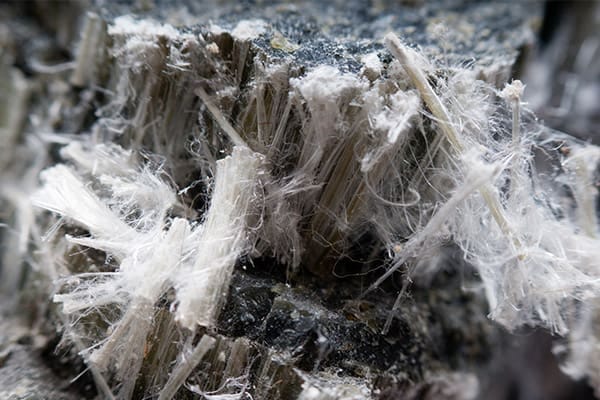
Asbestos has been used for more than 4,500 years.
It was first discovered in a Greek quarry.
It was called the “magic mineral” because of its fire-resistant properties. Early applications of the fibers were in textiles such as cloaks, tablecloths, handkerchiefs, and theater curtains.
In the early 1800s, textile makers in Italy figured out how to spin asbestos at scale. By the late 1800s, it was insulating the boilers, steam pipes, and turbines. Then, in 1907, an Austrian engineer named Ludwig Hatschek patented a machine that mixed asbestos with cement to mass-produce fireproof building sheets. Asbestos went from an industrial insulator to a residential building material.
From there, it poured into homes. Asbestos was in most American homes built between roughly 1910 and 1980. It was widely used in lots of different building materials because it is cheap, strong, and resistant to heat, electricity, and corrosion.
*****
So what happened?
The short version is that the health evidence became impossible to ignore.
Researchers connected asbestos not just to lung scarring in heavy industrial workers, but to mesothelioma, a cancer that can follow even low-level exposure. Through the 1970s, after employees filed lawsuits, asbestos companies began listing warnings on asbestos-laden products. The EPA enacted the Clean Air Act in 1970, classifying the mineral as a hazardous air pollutant.
The Toxic Substances Control Act (TSCA) further regulated the mineral in 1976, controlling the substance’s development, use, and disposal. After over a century, mining of the mineral ceased in the United States in 2002. The mineral was still imported into the U.S. and is used in some construction materials. However, in March 2024, the EPA banned chrysotile asbestos in the United States, which aims to stop using, manufacturing, and importing chrysotile asbestos.
This is still in active litigation with industry groups.
Wow. The story has not ended, and the presence of asbestos is still in many homes and buildings.
*****
Asbestos and health.
According to the WHO and the International Labour Organization, occupational asbestos exposure causes more than 200,000 deaths worldwide every year.
In the U.S., the Environmental Working Group estimates that 12,000 to 15,000 Americans die each year from asbestos-related diseases.
Asbestos diseases have a latency period of 20 to 60 years. So if you breathe the fibers now, the illness may not show up until decades later.
There is no known safe level of exposure.
Three main diseases come from it:
Mesothelioma, a rare and aggressive cancer of the lining around the lungs and abdomen. Asbestos is its only known cause, and median survival after diagnosis is about a year.
Asbestosis, the progressive scarring of lung tissue that makes breathing harder over time.
Lung cancer, which asbestos causes on its own and makes far more likely if you also smoke.
Why is it dangerous?
When asbestos-containing material is damaged or disturbed, those fibers go airborne. You inhale them, they lodge deep in your lung tissue, and your body cannot break them down or clear them out. They sit there for decades, causing inflammation and scarring.
*****
There are actually six kinds of Asbestos.
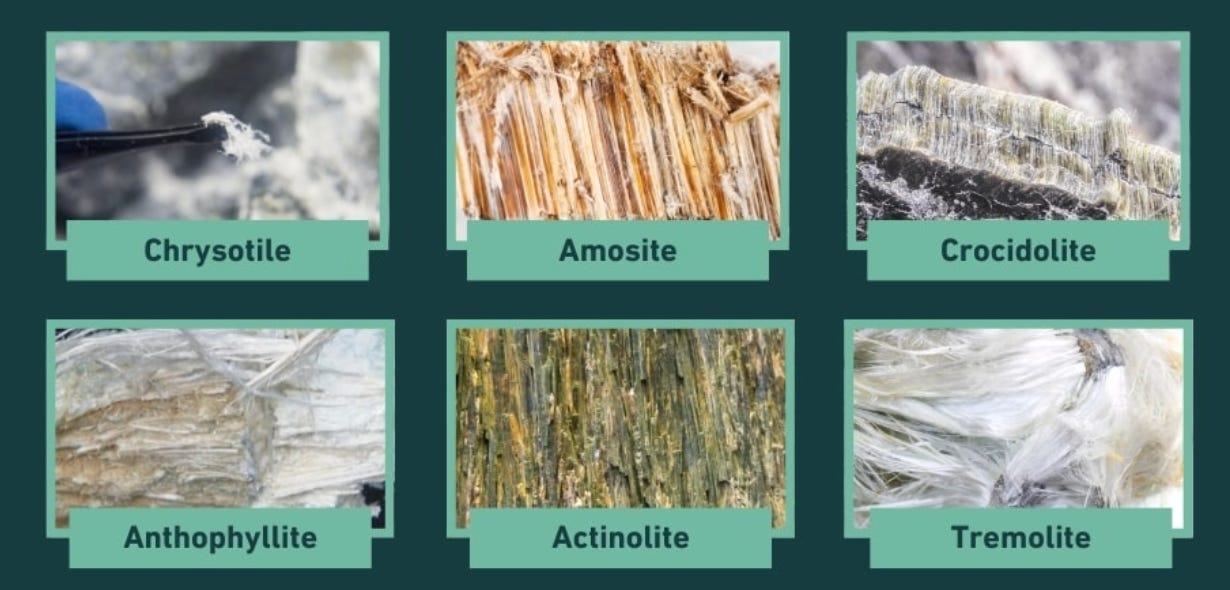
When we say “asbestos,” we are really talking about six different minerals in two families.
Serpentine has curly fibers, and just one member:
Chrysotile (white asbestos). The long, curly one. This is the asbestos you almost certainly have, if you have any. It makes up roughly 90 to 95% of all asbestos ever used in U.S. construction. If your popcorn ceiling or floor tile tests positive, chrysotile is the usual suspect.
Amphibole has straight, needle-like fibers, and these are the more dangerous ones. The needle shape jams deeper into lung tissue, which is why amphiboles tend to cause more harm even at lower exposure. There are five:
Amosite (brown asbestos). The second most common in buildings. Used in cement sheets, pipe insulation, and ceiling tiles.
Crocidolite (blue asbestos). Widely considered the deadliest. The fibers are extremely thin and easy to inhale.
Tremolite, actinolite, and anthophyllite. Rarely used on purpose. The real problem is that they show up as contaminants in other materials, including chrysotile deposits, vermiculite insulation, and talc.
*****
Where it hides in a home.
If your house was built before 1980, asbestos could be in a lot of places. The EPA’s own list of where it commonly turns up includes:
Vinyl floor tiles, plus the backing and adhesive under vinyl sheet flooring
Hot water and steam pipes coated or wrapped with asbestos insulation
Oil and coal furnaces, and their door gaskets
Textured paint and patching compounds on walls and ceilings
Roofing and siding shingles
Vermiculite attic and wall insulation
Asbestos paper, millboard, or cement sheets around wood-burning stoves
The good news. Exposure happens only when asbestos-containing material is disturbed or damaged in a way that releases fibers into the air. Intact material left alone is usually the lower-risk situation, which is why renovations and repairs on older homes are the classic exposure event.
*****
So how do I know if it’s in my home?
You cannot identify asbestos with your eyes. You have to test for it.
So it is important to test if you are about to renovate, remodel, or demolish anything, or if you see damaged, crumbling, or water-stained material in a pre-1980 home.
Here is how testing works. You hire a certified asbestos inspector who takes small samples of the suspect materials and sends them to an accredited lab. Targeted inspection and lab work usually run about $250 to $850, and a whole-house inspection can reach $2,500.
It is NOT recommended to collect the samples yourself.
*****
So if the test comes back positive for Asbestos, what do you do?
You have two legitimate options, and a certified inspector will help you pick based on the material’s condition and your plans.
Encapsulation. You seal the asbestos in place with a specialized coating so the fibers cannot escape. It runs about $2 to $6 per square foot, roughly 30 to 60% cheaper than removal, and the EPA approves it when the material is in good condition and unlikely to be disturbed.
Removal (abatement). Required when material is damaged, crumbling (the technical term is friable), or in the path of a renovation. A single contained area typically runs $1,200 to $3,300, while whole-home projects can reach $30,000 or more for something like friable attic insulation.
*****
For the nerds.
Why is asbestos so specifically good at causing cancer when we inhale dust and particles all day?
It comes down to geometry and durability. Most particles your lungs take in get cleared by mucus and cilia, or eventually broken down by immune cells called macrophages. Asbestos fibers defeat both systems. They are long and thin, so they slip past your upper-airway defenses and travel deep into the lung. Then they are too long for a macrophage to fully engulf, so the immune cell essentially gets stuck trying, dies, and releases inflammatory signals.
This is called frustrated phagocytosis. It is a chronic, low-grade inflammatory response happening at the cellular level for decades, and that persistent inflammation and scarring are what eventually drive the genetic damage behind mesothelioma and asbestosis.
*****
If you are doing any DIY renovations at home, make sure to add a check for Asbestos to your list.
Hunter